Saturday, July 4, 2020

Bottoms Up, Or, how to hydrate at events

A few things to consider and a quick word on a pet peeve...
In the 1860s, drinking water was only beginning to be filtered, purified, and treated for the various water-bone illnesses we know today; so, the Citizen had different drinking habits entirely. 
The Citizen, also, lived and traveled in a different social-hospitality construct. 
So, your Citizen would have had a drink before s/he left their home, would have been offered a beverage when they visited friends, bought a beverage at an establishment, and drank from creek to hand with a glance for obvious unhealthy pollution (like a rotting carcass). The Citizen would also have thought little of going up to a house, knocking on the door, and asking for a drink... which they likely would have been provided. 
The Citizen would also have been drinking a lot less than we do today. When water is suspect and beverage availability uncertain... one tends to simply not drink. Not an option for the modern interpreter at a hot event. 
Very little of the above happens at events, save offering a drink to “visiting” friends and the occasional beverage establishment. 
So... we must look to do something that is outside of the everyday experiences of those we portray... bring beverages along on a “quick day trip”. 
Thus, in researching, we will look to the occasions our Citizens did have to bring beverages along... hunters/sportsmen on day-long excursions, picnics, and bought-beverage packaging... and also, long voyages with uncertain re-provisioning, such as westward migration. 
So... look to your event. If you are portraying your own home... grab a bucket to get water from the centralized event water source and serve it from pitcher to glass. If you are “in town”... look towards a flask, bottle in a basket, or possibly a sportsman’s canteen. If you are a commission agent, Army-associated, or other person who goes in to the situation knowing water access will be uncertain... look to sportsman’s canteen or bought beverage packaging. 
The Things you carry support the Story you tell as much as the clothes you wear and the physical space you create. Not just “any old thing” will do... it may say something about your portrayal you don’t intend.
A few more tangents ...
***Iced tea was seen among beverages for invalids. Hot tea was the method for healthy adults. In hot, humid weather... the idea of hot tea leaves us UG!  ...so... lemonade, fruit vinegar, switchel, an infusion of mint and ginger sweetened to taste and served over ice... lots of choices, just not iced tea.
***Switchel... I’ve been looking for almost a decade and have not found published recipe or instructions that substitute honey for molasses or include honey in addition to molasses. When I request of the Hive Mind, I get lots of “well, it just makes sense, they used honey as an alternate sweetener so often.” Agreed, it was common substitution for sugar... but I can’t find it in direct reference to switchel use. If anyone can... please share. 
***Yes, “mucket” is a military and sportsman item... so again, if you want to use one, have your sportsman catalog handy or expect to remind your military fellow participants that they were available private purchase at the period equivalent of Colman and you were not stealing from the dead. Keep in mind, they have a lot more fun accusing you of stealing from the dead. 
***They were less likely to drink from the storage container. There’s a reason Mother scolds you to use a glass.
Please see my blog archive for recipes and further info on beverages.

Monday, March 25, 2019

The Brave 2/3; Or, No Bevis, Not every man was a soldier in the Civil War

Few things can bait me into rage like bullying. I was bullied. I know the signs to look for. I know the behaviors that, if left unchecked and without comment, will wear away at the confidence and the soul.

Years ago a friend who portrays a civilian man of the mid 19th century encountered a fellow male civilian re-enactor. As such situations do, they got to talking about The Hobby and previous experiences. The new friend asked my friend if he'd ever had military re-enactors make snide comments about portraying a civilian, imply that he was less of a man because he didn't portray military, or question his sexual orientation because he took time to dress as a fashionable civilian man. My friend replied that he had his own experiences and they went on to compare the nature of those uncomfortable incidences. 
That conversation sticks with me as I interact with both military and civilian re-enactors.

A casual survey of fellow re-enactors on how they would respond to a military re-enactor questioning civilian men about military service brought on a flurry of "I portray a civilian," "He needs to read up on real history," and "Ignore his idiocy." 
What I take away from those responses is that we have become accustomed to bullying to the extent we let it pass without comment.

Here's a few facts for the fire.
There were approximately 11 million males over the age of 16 at the time of the Civil War. 
Two-Thirds of those were civilians. 

The government at the local, regional, state, and federal levels were predominately civilian men.
   Such as John Cook, mayor, and City Councilmen Lewis Wilhide, George H. L. Chrissinger, Charles H. Henson, Richard Sheckels, Ephriam W. Funk of Hagerstown Maryland. 

The leaders in business, industry, and community services were predominately civilian men.
     Such as Superintendent John A. Kennedy and Commissioners Thomas Coxon Acton and John G. Bergan of New York City Police Department

Civilian men provided oversight and management of the majority of businesses.

Civilian men advised women on the maintenance of farms, law, and business dealings.
     Such as Harvey Bear and William Heyser

Civilian men enabled women to conduct their business; co-signing credit, loans, contracts, and banking.

Civilian men did many jobs that were still thought appropriate for only men, despite the women flooding the workforce.
     Such as Gunpowder manufacture which we learn from "Employments of Women" by Virginia Penny, 1863 reported no female workers.
     
Civilian men founded the commissions that ensured sanitation, supply, and assistance.
     Such as Dr. Samuel Howe, Rev. Dr. Bellows, and Frederick Law Olmstead

Civilian men contracted many of the support services for the military; everything from hospital nurses and teamsters to produce merchants and grave diggers.
     Such as Walt Whitman and "Uncle" Jim Parks

Many civilian men were veterans of previous military engagements.
     Such as John Lawrence Burns of Gettysburg

Men of color could not enlist until 1862, previously serving in civilian support positions.
     Such as William Wood and James M. Peters

There were laws, edicts, and decrees in place to ensure the civilian men needed to maintain the communities, states, and country could get exemptions from service. 

So, with 2/3 of the men not in military service during the Civil War, a large portion of re-enactors should be choosing to portray civilian men. Instead, the few who do are met with bullying behavior worthy of a school playground.

Why shouldn't we ignore the idiot? 
Because the face of Civil War era re-enacting is changing. We are engaging potential members all the time. The War affected the whole population, so we have room for everyone. In each encounter we have the chance to share history as it was and without civilian men, the history is incomplete.

One can't have a Civil War program without a Civil War soldier, but without civilian men the story is only a third told.


Thursday, September 13, 2018

It's All On The Line Together


A Dear Newbie has stumbled into a common misconception today and we should clear it up.
The flawed logic goes something like the following:
If Dear Newbie is a man, ...
...he knows about men's clothes...
...he is not a woman...
...he does not dress as a woman...
...he, therefore, would not know anything about clothing for persons of the female gender.

Whoa, whoa... Hold up there, Pard... that dog is maybe not gonna hunt.

Sure, Dear Newbie is a man and will research men's clothes...because he wears men's clothes. He'd also know some basics of women's and girls' clothes because he knows women (and probably girls too.)
Dear Newbie has a Mother and likely sisters too. They wear women's clothes. So, growing up, his drawers and Sister's drawers were beside each other on the clothesline and Mother's chemise was mended right along side Father's shirts. The conversations may have been whispered and not spoken of openly... but he may have heard about a "lady's time" too.
Dear Newbie, unless he is particularly naive, has likely assisted a woman out of her clothing at some point.  So, he has a basic idea of how women's clothing functions. He may fumble it and need her help, but it's not completely foreign.
If Dear Newbie is a common kind of man, he's likely married and he'd be passing familiar with his wife's clothing, though he doesn't speak of it and will call out anyone else who does.
 Perhaps Dear Newbie and his lady have been blessed with children. There's a chance some of those children will be girls. Girls who will wear female clothing. Who's clothing will go on the line next to Sonny's drawers and in the mending box next to his shirts.

The same can be applied to the Dear Newbie who is a woman. Men's clothing would not be as familiar as her own, but it would not be as foreign and scandalous as we often make it out to be.

So, we do a disservice to the people of the mid 19th century when a man cutely says, "I don't know 'nuthin' 'bout women's clothes."
They knew about clothing of the "opposite gender," they just didn't openly talk about it. Just like We don't openly talk about what goes on in the bedrooms of other people, and really prefer not to think about it too much (despite our love of celebrity scandals), Persons of the mid 19th century knew about clothing and just accepted it was there.
If we are to portray a person of the mid 19th century with a full range of knowledge, it's time we learn the basics of clothing the "opposite" gender.

Friday, January 26, 2018

Can I have your pattern for that? ...another rant.

If the Dear Readers will indulge me in one more rant, I promise to put up something... less angry... in the near future.

A tailor makes clothing patterns by drafting. It's a competitive profession. We compete with not only fellow professional tailors but also with every home crafter who has heard from her/his mentor that she/he can save money in re-enacting by sewing him/herself.
 "Making a frock coat couldn't be that hard. After all, Saint Grandma made ALL their clothes when they were small," quoth Crafter. So, they ask what pattern they should use to make a period correct frock coat or over-coat or trousers or waistcoat. Well, there are a few folks out there who put out patterns commercially. The pioneers in commercial patterns for the re-enactor market did their best to fill a niche. Others joined in with more detailed research and more solid patterning skills. They're still around.
There is still an unfilled niche in the commercial pattern pantheon, and I hope to fill it some day.

In the professional world, it is bad form to say negative things about a competitor. Even Saint Grandma agreed with a chipper, "If you can't say something nice, say nothing at all." My Grandmother and Mother instilled in me a sense of fair play too. Everyone deserves a chance, don't kill their chance with a careless word.
So in the competitive world of tailoring for re-enactors, I may keep an eye on the commercial patterns available, but I haven't used them in years. So I haven't tried out every commercial pattern for menswear there is. If I haven't tried it, I'm not recommending it.

Drafting the pattern is just the first step in making a garment. A tailor is in charge of everyone who does work for him, so he needs to be proficient in each phase of garment construction. He knows how to draft patterns. He knows how to fit bodies. He knows how fabric will behave. He knows the right stitches to put in what places to achieve the desired effect. He knows what is fashionable and when that's appropriate. He knows what is classic and how to maintain it. He knows what is out-dated and how to talk a customer out of it. These are not easily acquired proficiencies. These are not skills conveyed in a commercial pattern, even ones with stellar instructions.

I recently heard an excellent comparison. Asking a tailor to recommend a pattern is like going to a gourmet restaurant and asking the Chef for the recipe to his signature dish. At best, he'll recommend you buy the book in which he placed that recipe. At worst, you're mucking about casually with his livelihood. If you can make the signature dish at home, you won't come to the restaurant to buy it from him. If you don't go to the restaurant, he'll have to close it. He'll then be out of work and searching for a new job.
If you can make a tailored garment at home, you will stop patronizing tailors. We'll be out of a job and looking for new work. Not to mention we have to look at all the cut corners and lack of innards in your work at the events we attend. "Where'd I leave the acid-reducer?"

I'm not gonna let that happen to me nor any of my fellow tailors. So darn tootin', you ask for a pattern and I'm gonna recommend a tailor or shirt-maker.

Thursday, December 28, 2017

Will This Work? ...a rant

The Old Hats are frustrated today and not feeling their usual generous selves. On a usual day, we are happy and relived to be asked 'Will this work" before a purchase is made, because it gives us a chance to spare Dear Newbie the expensive and soul crushing mistakes we have made. But lately though, it seems the questions are asked without forethought and the complex answers given are over-generalized or ignored outright in favor of convenience or romanticism.
Since no one likes to see a beloved mentor in mental distress, I thought I'd give a few thoughts on why the query "Will it work" is being received less generously.

Our objective is to tell a story. It doesn't matter if it's at a battle re-enactment, a living history show-n-tell, a museum, or gallery exhibit... we have a story to tell.
We are telling the story of a person or people in the past. We share who they were, what they might have felt, how they lived, how The War impacted them (or didn't), what they thought and why that might have made sense to them, where they've been, where they are, and where they hope to go.

Each of the things we choose helps us tell that story. The wardrobe helps us tell the story. The housewares help us tell the story. The environment helps us tell the story.
Because each of the Things helps us tell the story, we must make each choice with care. Not just any old Thing will do. It must be a specific Thing that reflects the choices that might have been made by the people of the story we are telling.
It is easy to say "this Thing was available, therefore, I choose it." That Thing was likely not the only Thing available and we want to make sure the version you choose supports the specific story you are telling.

So, just like you go through your list of questions when choosing your wardrobe, apply your questions to your housewares and environment too.
Could I spoon-feed you an answer of "buy this"? Yep, sure I could. But you would not understand why I recommended that Thing among all the Things available.

 If I lead you through a thought process on how your Thing will support or confuse your story, you will decide for yourself what is the right choice of Thing and more easily defend your choice to others with independently verifiable sources.

Tuesday, December 27, 2016

Accumulated Knowledge and Interpreting Foodways History

Dear Newbie is excited to have been given a great gift, a reprint of an historic cookbook. She questions if it could be taken to an event for reference, since copying out the recipes is tedious.

Let's consider this question.
Cooking knowledge is a sticky situation due to the nature of how foodways are learned "in real life." Everyone must eat, so from the start everyone has someone in their lives cooking. Recipes are introduced, become trends, become classics, and pass from fashion... or morph into something new as technology changes the way we cook, acquire ingredients, and experiment with substitutions.

Assume an interpretive focus of 1859-1865. In theory, any recipe published or traced to before 1865 should work; but does that accurately reflect the foodways of your portrayal? In many cases, it does not because your portrayal did not gain the sum total of your foodways knowledge in a single dose from a single source.

I'll give an example from my modern life:
A holiday tradition in my family is the breaded fresh ham sandwich. A basic recipe is thin-sliced pork, dipped by turns in cracker crumbs and egg-milk mix, and fried. I learned this dish from my grandmother who used "fresh ham" and saltines crackers, fried in vegetable oil in an electric skillet. When she had news that she and grandpa should reduce salt and canola oil became the new healthy alternative to straight vegetable oil, she switched to no salt saltines and canola oil. My mother thought butter crackers would give a richer flavor, so she used those instead of saltines. I am often unable to find "fresh ham" and must substitute a pork loin. I accommodate a friend with Celiac disease by using gluten free herb crackers akin to butter crackers. I dislike frying because the oil spatters, so I oven fry my breaded "fresh ham." Were I to trace this family recipe back even further than my grandmother, would I find ship's biscuit or bread crumbs for batter, frying in oil or lard or butter?
Were I, my late mother, and my late grandmother to publish cookbooks, we'd each have a very different recipe for this one "classic" dish.

In the mid 19th century, cooking knowledge was similarly acquired. You were taught basics as you grew up that reflect your family and their traditions. Situations such as health or availability caused substitutions that may have changed how your descendants would learn the recipes they watched you make.

So how does that help us judge recipe books for interpretive purposes?
Consider your event goals, not just over-all interpretive strategy that governs how you approach the hobby, but the interpretive goals of each event you attend.
If your goal is a survey of era appropriate recipes for your own edification, then learning several recipes from a book in which the instructions seem clear is an excellent introduction to historic cooking.
If your interpretive goal for the event is to showcase foodways of 186x generally speaking, then you can include a survey of books published in several dates prior to 1865. Showing 1820s & 1830s recipes that have become "classics, 1840s & 1850s recipes that are "family staples," and a few from 1860s that show the "newest trends" and "innovative technology" provides a solid context for the accumulated foodways knowledge of an average person of 186x. In short, bring the book if published 1830-1865.
If your interpretive goal for the event is to "Live as people of 186x for a weekend," then your specific circumstances need to be considered. Take your age and pinpoint the year your portrayal was born if the event date 186x was "today." Pinpoint the years for ages 10, 20, and the years you would have married or begun your own household. Pinpoint the years for major changes in circumstance, such as a big promotion for your husband that requires more fashionable entertaining to maintain "Place" or a season or two after imported goods become scarce. These years will be your targets for which your foodways knowledge would shift. Again, you're separating into three categories: "classics," "family staples," and "fashions, innovations, & substitutions."
I am 42 years old and let's take 1862 as a target date. I would plan my menus to use memorized recipes published 1800-1845 to reflect those I would have learned from watching my female relatives growing up, I might reference a "well loved" reproduced recipe book published circa 1845 for a complex recipe to reflect those that have become family staples I would make every-day, and if entertainment is involved I might include a clearly trending recipe from a reproduction of a barely used 1861 book or 1861 clipping from a magazine.
In short, choose the book carefully based on who you portray.

With a wealth of period cookbooks available online in digital collections and being reproduced by specialty publishers, we're able to think beyond convenience to add depth of knowledge to our portrayals, if we remember that foodways are an accumulation of knowledge and practice rather than created full formed in a single go from a single source.

Online Chronologically Organized Cookbook Collections:
The Feeding America Project
Historic Cookbooks Collection 1800-Civil War
Manuscript Cookbooks Survey


Friday, October 28, 2016

My Menfolk need clothes and I don't have a clue where to begin! Please help!

As a tailor I get this same desperate plea every few weeks on FaceBook. These questions and pleas have inspired blog postings that I expanded into a presentation. Today, I will list the blog posts in an order for making a plan for a Wardrobe Toolbox. Dear Newbie, I assure you, your menfolk need more than just clothes for sharing history; but don't panic, we have a plan for that.

Where do I begin?
You start by assessing the events you plan to do. Remember that military portrayals and civilian portrayals need to look at their events and therefore wardrobes differently.
    Assessing Your Events, and what that can tell you
    A Citizen Considers His Wardrobe

Then proceed with a Starter Pack to get you through the first events. Borrow garments, if you can, while you save up for quality garments. Follow the Starter Pack with an Expansion Pack for the Primary Core. (By this time, I'm using "insider jargon" and you need clarification. Read on.)
    Advice on a Wardrobe Core
    Man's Wardrobe Toolbox

Remember not to stop with clothes. He'll need "stuff" and a means to carry it, and those items can say a lot about his portrayal.
    Shlep Like a Mule
    Portable First Person; Or, The Right Mind, Part 2

But Wolfie, isn't there an easy checklist?
No, not really. Non-military men have so many variables to choose that a checklist is really difficult. The closest I can come is The Best Bet Wardrobe For Men and Older Boys. 

For those in middle age portraying professional class or middle class men, here's special advice for sorting out what is correct attire for which activities.  Stallion Dressed As Colt

And finally, some advice on why "fitting in" is so important to 19th century dressing, and thus, should be likewise in recreating 19th century dressing. The Zen Of Common

Tuesday, June 7, 2016

Connection in an isolating age

Effective re-enactors understand that we must form a connection with those with whom we share history. We also lament that fewer people are understanding history, especially the less pleasant aspects. This leads to a more tenuous connection with those who need the connection most.

I interpret history near Washington, D.C. The requested interpreters are young, white men who portray Civil War soldiers. I am not young, male, nor portraying a soldier. Most of the people with whom I am sharing history are not in that demographic either. Are we really making the connections that lead to understanding history?

While I can talk about the Civil War soldier and the battles of the area, they can't "see" the battle from the soldier's perspective from my telling. They can't relate to a young, white, male soldier. They can't "see" themselves 155 years ago. 
To effectively share history, I need to show a different perspective.

When I share about a battle, I share the perspective of a middle aged white woman, a businesswoman, a professional care-giver. The middle aged white women can relate to my perspective. They can "see" what that battle may have been like for them.

A friend is a white man of middle years, a professional man who has worked hard for his settled position and establishing a secure home for his family. The middle aged white men can relate. They can see the choices they may have made through the choices depicted by my friend.

The demographics of the DC area are changing rapidly.
It's one thing for me to include the stories of black Americans in the hospital systems as I speak of women in the hospital systems, that makes a connection with the black citizens of modern DC, albeit tenuous. The connection is that much more strong when my friends who are black Americans tell the stories of the USCT, or the free teacher on her first day, or the enslaved cook who "ain't nobody's mammy!" Suddenly history is not just the story of some white man in a boring book, it's a living, breathing person like them.

With a wealth of immigrants coming to the DC area, I've been working on portrayals of several immigrants. When one of my portrayal shares her fears of leaving all she has known for an uncertain welcome, or wading the paperwork river to citizenship, or trying to make a life amid anti-immigrant hostilities; they can see they are the newest in a long tradition of making America home.

When we share these different perspectives of a battle or of The War in general,  those we share history with can connect. They can "see" themselves 155 years ago; the choices they might have made, the challenges they may have faced, the opinions they may have held because of their experiences. They know where to begin to ask questions and explore experiences, because the interpreter shares mutual challenges. History is more tangible. History makes a connection. History is a Person. One can connect with a Person.

**************************************

And if you are so inclined, please sign this petition to have a visitors' center and park rangers assigned to the African-American Civil War Memorial in Washington D.C. With a Visitors' Center and rangers, this national monument can further the interpretation and connect with DC's and Visitors' experiences of History. Petition.

Wednesday, April 27, 2016

I am, I am SuperWoman... or not.

SuperWoman Syndrome

The romantic ideal that women of the past did all the cooking, cleaning, sewing, child-rearing, gardening, entertaining... for their families without resorting to Professionals. Did it perfectly. Did it from scratch. Did it without mistakes. All while passing on the homey values to the next generations.

Were there women who were SuperWoman in the 19th century?
Yes there were. We have Martha Stewart, Rachel Ray, Oprah. 
They had Eliza Leslie, Elizabeth Acton, Miss Beeton, the local woman every woman loves to hate.
Most women, though, were not SuperWoman. They may have made the best pie in the county, but had to hire out their sewing. They may have put the local tailor to shame, but everyone was scared to visit her house until The Girl came by to "help" with cleaning.

Newbies, you do not need to be SuperWoman either.
As a matter of fact, it would be more accurate if you were not.

Almost all women could do the "basics" of cooking, cleaning, sewing, and child-care. They had their focuses too. 

  • If you do not sew, keep the professionals employed. (Most will work long distance and attend lots of events, the better to reach their customers in person.)
  • If you do not cook, make arrangements with someone who does.
  • If you need help at an event with your children, chances are good other mothers will too, so get a co-op play date together.

...and what you tell the Public does not need to be the arrangements you as a re-enactor make for the event.

In many cases, it over-represents SuperWoman for you to tell the Public that you have made as much of your family's clothing as you have. We don't have the same ready access to professionals, ready made shops, and second hand markets, so we have fewer choices. 

I am a tailor. I spend the majority of my time clothing menfolk. Did I make my dress? Yep, sure did. But I look the Public in the eye and say that I employed the local dress-maker... who got a nice frock for her husband in exchange and the transaction was happy on both sides. Does this "hide my light" on my dress-making skills? Yep, and sometimes that is needful to present history as it was instead of stroking the modern pride. Besides, tailoring and dress-making utilize different sewing and patterning skills and knowing one does not mean one knows the other.

We have examples of 19th century women who made the clothing for their family, including tailored garments. In many cases, it was the necessity during the war years that caused women to think "yes, I think I *can* do that." So in post-war years we see many more home-crafters daring to make their own clothing, using professionals less, and professionals using machine work. It's part of the innovations the war years caused on garment manufacture (like standardized sizes in menswear.) Look carefully at those sources and how often the author mentions extended family and neighbors doing household/farm work for her. She's not really SuperWoman either.

In short, though, Dearest Newbies You do NOT need to be SuperWoman to be a re-enactor.

Friday, April 15, 2016

I am the very model of a modern...

Dear Newbie has indulged today in a movie set in our favorite era of history. The movie is set in 1862. The dresses are from fashion plates of 1862. The suits are from cutting plates of 1862. The carriages, traps, buggies are all straight out of the 1862 catalog. The dishes on the table are documented to have been introduced in ...you guessed it... 1862. The action is accompanied by songs published in 1862. The entire scene dates to precisely 1862... so why does it seem so "off"?

The production team has used what we have come to call "Model Year Syndrome." We in re-enacting sometimes do something similar.
Progressive Military will often lament, "He thinks all soldiers were sprung full grown from the head of Mr. Davis in 1861!"

When we look through our recipes, housewares, and well... almost everything but clothes... we often fall into this Model Year Syndrome. We forget that we didn't spring to life full grown in 186x, so sometimes our knowledge needs to be outdated for 186x.

Take our favorite food recipes. Many will rely on recipes and cook books published in the 1850s and 1860s. This is a great start, because we can at least document the recipe as being available to some citizens in 186x. But we haven't considered where our portrayal would have learned that recipe. Would our portrayal have learned that recipe from a book or would she have learned it from watching her mother, grandmother, or another female relative? 
For my portrayals, I am roughly 40 years old and would have begun a household in the mid 1840s. I tend to rely on recipe books from 1800-1845 to learn what my portrayal would have been making in the 1860s. 

I likewise look to housewares with introduction dates between 1800-1850 to outfit my home. my portrayal would not have bought all her household goods at the same time, nor would they have needed replacement at the same time. So, a mix of "Model Years" is appropriate.

This can also be applied to "common knowledge" like home medicine, household cleaning techniques, handwriting styles, a whole host of everyday knowledge. Who you are and how you would have learned what you know are major factors in how out-dated or up-to-date your knowledge is on a subject.

Sure, it's cool to show off the "latest, greatest, most scientific" Widget of 186x to the people we share history with, but our portrayals may have had to be content dreaming of how the Widget would make their lives better, rather than owning one themselves. 
Don't forget, too, that just because something is available does not mean it is appropriate for everyone in every situation. 

So, Dear Newbie, enjoy a movie that mixes clothes from 1860 with a buggy from 1853 with recipes from 1812 on dishes from 1850 accompanied by music published in 1861. Ah! Much better! So real! 

Wednesday, March 9, 2016

Stallion Dressed As Colt

We live in a culture obsessed with being young. All the supposedly great things in life are associated with being young. Youth offers open possibility, healthful physical activity, vibrant creativity, unbound optimism, and faith in the hopefulness of the future. "Gather Ye Rosebuds while ye may" and all that.
There is the other end of the spectrum, being Old. Becoming Old is to be avoided at all costs. Old People are rigid in their opinions, tied to their traditions, afraid of change, feeble in their movements, dull in their conversations.
There seem to be only two options, you are either Young or Old.


Many re-enactors are taught to measure the success of their "Look" against a photograph from the era. The closer they come to matching that photograph, the more successful their portrayal is deemed. There is a major pitfall in this method for the menfolk. The men who portray soldiers are looking at photographs of young men. The average enlisted soldier of the Civil War era was 22 years of age. The average age of officers was 26 years of age. Theaverage age of the men portraying those soldiers and officers is older, often much older. They still hold their Look up to photographs to compare.

     So by the time the re-enactor portraying a soldier makes the decision to add a civilian portrayal, he's looked at hundreds of photographs of men in their late teens and twenties.
When searching out a photograph of a civilian to emulate, they gravitate towards photographs of the young men who look like soldiers out of uniform.


When they are presented with a photograph of a man in his late-middle years he looks stodgy, formal, Old... they are not that Old. They can't use that photo of an Old man because they are still young, active, vibrant men... just with responsibilities, family, civic activism, occupational experience... but they aren't "Old".

In the mid 19th century, Society took a different view of the middle years. They still encouraged the Young to enjoy a time of learning responsibility with a safety net and they still eshewed becoming Old as a burden to be avoided as long as possible. There was also a time in the middle.

Men in their middle years had the best of both Young and Old. They had the energy, optimism, and vibrancy of youth tempered with the authority, experience, and sense to enact change. Men in their middle years are the foundation of mid 19th century family and society. They are the civic leaders who bring their communities through War. They are the business leaders who bring trade, commerce, industry, technology, and social justice into the modern world.
In short, that stodgy man with dark hair, impressive beard, and a frock coat is not Old. He's an active, vibrant man affecting change on his world... just like you, Dear Newbie.

So, how does this paragon of Middle Age dress?
He chooses his attire based on the tasks of the day, just like you do. What "Look" does he need his attire to convey?
 If the answer is authority, responsibility, and stability; he will choose "business dress." For most of the 19th century, "business dress" meant a frock coat.

The fashions of frock coats changed up over the 19th century. A man in his late 40s in the 1860s would have lived through the introduction of a frock coat as the standard daywear, courted women in the frock coat at it's tightest, gone to War in a loosening frock, and luxuriated in the further loosening post-war styles... all before Ft. Sumter was fired upon. A frock coat was no more uncomfortable to him than a suitcoat is to a modern man. Perhaps not his favorite, but worn when appropriate because it IS the appropriate thing to wear in the situation.

In photo collections of university classes, the Professor is usually the one in the frock coat. While the scholars may show up in a square paletot of the latest fashionable cut, the professor would get a meeting with the Dean about "professional image" if he tried it.
The physician wears a frock coat because he needs his patients to have trust in his knowledge, learning, and techniques. He, too, needs to convey a seriousness, stability, and trustworthiness that comes from "professional" dress.
The lawyer, too, presents his cases in court and meets with clients in professional dress. The respectability, trustworthiness, and professionalism is conveyed through "professional" dress.

Were we to see these same men or any man of similar occupation at home on Sunday afternoon, or enjoying the Ag Fair or a base ball game, or having a drink with friends in the tavern; he may very well choose a loose paletot. Should he take leave of his practice to volunteer with the US Sanitary Commission or take the family on an educational Tour of Europe, again the loose paletot is the practical choice and any tailor worth his price would see he chooses conservatively fashionable style elements.
Consider blue jeans today. Almost all men have a pair of blue jeans (or several). The professor, physician, and lawyer wear their blue jeans to watch the ball game, go out with friends, play tourist, and volunteer on the weekends. Rarely will they wear blue jeans to teach a class, meet patients, present cases. Even then, a nod to "professional dress" is made or he faces a censure from a superior or mentor.
So too are blue jeans worn by men of all ages, but not necessarily the same style. The young men in "skinny" cuts differ from the men in middle years in "relaxed" or "classic" cuts, and differ too from working men in "boot cut" and "Western" cut.

The paletot we learn from Mr. DeVere on page 82 of his Handbook of Practical Cutting on the Center Point System (1866 edition) is,
 "...one of the most elegant styles of overcoat, and the one which is best calculated to suit all figures, all classes, and all ages. It may be cut of every degree of fullness:
* there is the close-fitting style, so well calculated to display the graceful figure of youth and early manhood;
*there is the medium style, which, while it displays the figure to the best advantage, combines that ease and comfort desired by those who have reached maturity,
*we have the square-cut style, so generally preferred by men who are given to athletic sports, from the great facility it gives for muscular action;
*and lastly there are the looser-fitting styles, so admirably adapted for men of middle age, who have arrived at a certain degree of corpulency."

There are some styles that were worn by men of almost all ages, but the context of when, under what conditions, helps sort out the "spot on like a photograph" from a near miss.
When looking at photographs to choose a style... make sure several men of your actual age are wearing that style and pay attention to the situations under which that style is used in the 19th century.


Friday, April 17, 2015

Assessing your events, and what that can tell you

Military fellows have it a bit easier. With a basic outfit and gear set, they can attend almost any event they'd like with assurances their portrayal will be appropriate to the event scenario. Maybe they're portraying a Pennsylvania infantry volunteer instead of their core Massachusetts infantry volunteer; but it's still a Federal infantry soldier.

Non-military men have it a bit different because our portrayals change drastically based on the portrayals appropriate for the specific scenario. And we need a suit and gear for them all. From a plantation owner with a medical degree in Virginia to an apothecary in Pennsylvania to a farmer in Maryland to a canal boatman in New York to a river boat pilot in Ohio to a statesman in Washington City giving a speech.

The first step in compiling a functional Wardrobe Toolbox is assessing the events you do to see exactly what portrayals you do most and what their wardrobe needs are.

Make a list of your events in the last three to five years. Then notate some information about what your portrayal was at those events.

Of course start with the obvious, your occupation and a generalized category for your economic and social status; but don't stop there.

The activity we see your portrayal engaged in or the occasion depicted at the event- At many events, the event depicted is a special occasion or an interruption of the daily routine of our portrayals. If your events only include a work day, you can likely skip the Sunday Suit. Allow that not seen wardrobe piece to be a presence in your mental inventory rather than your physical one. In other words, if you asked your portrayal to list his clothing, he would tell you he owns a Sunday Suit, but you've only ever seen him in a denim trousers and work-shirt in the wagon.

The season of your events- these guide the types of weather protective garments you'll need. If your events center in the warm months, you maybe don't need a top coat but will spend the extra for a great straw hat.

Interior/Exterior- like the Season, this guides the types of protective garments you'll need. If a lot of events are outdoors in morning grass, those rubber over-shoes are a priority, whereas all the interior winter events means you can skip the snowshoes.

Number of Days you dressed for the event- this will guide how many of each garment you'll need minimum.

If you were to put that information into a spreadsheet or chart, using a set group of terms, you would quickly see the patterns emerge.
You might see that you portray a professional class and trade class man in the medical professions, in transitional seasons, mostly in historic buildings, for at most 4 days.
From that, you can start compiling a wardrobe of professional class garments that can be dressed down with choice less nice pieces, some rain gear and and warm layers. You would see that you could skip the full dress suit and the heaviest winter top coat. You'd see you'd like about 5 shirts and drawers for the 4 days you'll dress.

You could also use this assessment to chart your gear, from your bedding and dishes to your Personal First Person.

Resources:
Event Assessment Template


Tuesday, November 26, 2013

Advice on a Wardrobe Core

A Dear Friend is trying to make sense of what his civilian wardrobe for re-enacting should consist of. Today, I will use a friend's wardrobe as an example to try to shed more light on the topic of a "mix-n-match" wardrobe core that I introduced in "Best Bet Wardrobe for Men and Older Boys". Other postings that might be helpful include: "A Citizen Considers His Wardrobe" and the series, "Do I Know You?"

Before one can discover what garments will be most appropriate, one must first evaluate the types of events, occasions, and tasks he will attend, paying attention to the aspects of life that will affect clothing choices. That’s the subject of an article of it’s own, so I will draw your attention to the pertinent information.

My friend is in his middle years, with a professional class background to call upon, and lives in a temperate climate. His re-enacting season usually lasts from late March through early December. He seldom camps, but does attend events where leisure attire is convenient. He prefers to tailor his portrayal to the event scenario. An average season will see him portray a factory worker, a farm worker, a small town physician, an apothecary, a plantation owner with a medical degree, and a surgeon with the Federal Army medical department.

With such a list one might think my friend is a “clothes horse” to have so many suits of clothing and question how anyone can afford to have clothes for each of those portrayals.

He has created a wardrobe toolbox. Think of it like Legos or trading cards. One has several starter packs to choose from and each “world” has expansion packs that will compliment the starter pack.

My friend’s starter pack consists of 4 shirts (2 white, 1 calico, 1 check), 4 pair of drawers, 6 hankies, 6 pairs of socks, a pair of shoes, a pair of dark blue wool trousers, a wool waistcoat/vest, suspenders/braces and 2 cravats (one green, one black).

His first expansion pack gives him pieces appropriate to working portrayals. It includes a wool over-shirt, a neckerchief, and a soft cap. He has a further expansion pack for cold weather that includes a wool pilot coat, knit comforter, and mitts.

His second expansion pack gives him pieces appropriate to office and professional portrayals. It includes a wool frock coat, a plush top hat, and a pocket watch with a locket fob. His winter expansion pack here includes a wool shawl, leather gloves, and a walking stick.

Just like Legos, separate pieces are available to offer more variety. My friend chose to add a second pair of wool trousers in a cheerful windowpane check, a snazzy silk striped waistcoat, and the Death By Fuchsia cravat. He also added a sporty coat to take his working class portrayals to town or his wealthy portrayals on a casual outing.


Because he avoided pieces that were appropriate for only upper or only lower classes, most of his garments can be worn in the appropriate occasions no matter the “class” he’s portraying. 

As he's gown and expanded as a re-enctor/living historian, different garments have become the focus of his core and he's sold off some of his original starter pack to re-invest in solitary pieces he now has the experience to know he'll find more useful. 

Start small, build slow, invest in quality rather than quantity, maintain carefully. 


Links:

**Please note the photos are property of the respective photographers and may not be mined, reprinted, or copied without express permission of the owner. There is a good reason names and photo tags are not used here. Please respect that choice. Thanks. :-)


Thursday, July 11, 2013

Portrayal Series: Second Hand Clothing Dealer

Recently I have been privy to a few Dear Newbies who are considering whom to "portray." Also, I recently put together a new "portrayal" that was kinda special. It seemed a perfect opportunity for a new series.

A Bit of Background...
I had the opportunity to participate in the Civilian Town of Purdy for the 150th Anniversary of Shiloh by the Blue Gray Alliance. This gave me a chance to explore a new method of civilian re-enacting at a large "battle event." I was impressed with the possibilities of this event model. When the opportunity to participate in the Civilian Town of Gettysburg at the Blue Gray Alliance 150th Gettysburg came up, I wanted to come up with something special.
One goal of these civilian towns was to give civilian re-enactors a chance to create a "camp" that was a bit more like a "town," only with canvas standing in for permanent buildings. A few hearty souls dared to select artisanal crafts and aid societies to "display", but most selected to feature a canvas home. With a firm belief that homes are only a start to creating a "town," I wanted to add some period commerce to Gettysburg.
I am a tailor of re-enactment attire "in real life" and recently added in a ready-mades line. I am often called upon to illustrate the various layers of civilian clothing worn by people of the mid 19th century. I have created clothing for several mannequins to demonstrate this. In short, at any given time, I have a lot of 19th century clothes I can call on.
A favorite topic of mine is how people of the 19th century acquired their clothing. Putting my clothing stash together with a desire to add commerce to Gettysburg and share how people acquired clothing... I chose to portray a second-hand clothing dealer.

Clothing Dealers of the 19th century:
In an era when clothing patterning was still in the hands of elite artisans, every garment produced must be used to it's full. The second-hand clothing markets answer this need in many ways. Modern folks tend to hear "second hand" and associate with inferior goods and inferior work, worn by inferior people. Such associations tell only one small part of the second-hand story.


How clothing becomes "second hand" in the 19th century:
  • Garments produced by tailors or dress-makers that have gone unclaimed by the customers for whom they were produced might be sold to a second-hand dealer for re-sale.
  • Wardrobe from someone who passed on might be sold to a second-hand dealer by surviving relatives.
  • Garments might be sold to a second-hand dealer to off-set financial obligations or facilitate a new purchase.
  • Prisoners, Asylum Inmates, and Poorhouse Inmates might have garments sold to a second-hand dealer to pay for their treatment. (There's a good reason second-hand dealers are known as "ghouls" and "vultures" in period literature.)
Garments might be sold to second-hand dealers several times in their lifetime, finally bought by the "rag-n-bone" who would sell them for pulp or scraps.

A person starting as a second-hand clothing dealer would begin with a pack basket of clothing and travel from town to town, stopping at farms along the way. When business picks up, he might acquire a cart or wheelbarrow and may decide to stay closer to an urban area. He would make a point to attend the Market Day given in most small towns. Some larger urban areas had a market building and clothing dealers were quick to rent stalls there. A few clothing dealers would acquire buildings of their own for their enterprises.
The occupation appealed to many recent immigrants.
Canal Street Market in Cincinnati, Ohio ca. 1860 by Henry Mosler   Notice the clothing stall on the left, as indicated by the cage crinoline hanging from a fly peg


We acquired the 1860 Federal Census for Gettysburg early in the research process. There was no market building listed, but quite a few listings of "clothing" in the "occupation" category. I knew from other census research that "clothing" as an occupation might mean two things, either a second-hand clothing dealer or a ready-mades dealer. Voila, I could be in Gettysburg as a second-hand clothing dealer and it's supported by the census.

What's the difference?
A ready-mades clothing store is filled with clothing that not been owned or worn before. Second-hand clothing has been owned and likely worn before. Ready-mades is like Old Navy, Second-Hand is like a thrift shop.


Shop lay-out:
Because second-hand grew out of pack baskets and market stalls, some disorganization was needed. Clothing was sorted into loose categories and then displayed in piles. The customer sorts through for things they like, they hold them up to assess fit, and they buy or not. A few items might be featured on pegs along the wall.
Piles of sorted mens' and boys' clothing on one of two tables
The two tables and a peg in between them


My "shop" was a tent fly attached to a tent, so I had a ready supply of "pegs" for as long as my tent was supported. I added two tables (yep, modern plastic folding tables... period folding tables would have been ideal, but one works with what one has.)
Tent Posts filling in as "pegs" for "better items"

I chose a unique method of shop identification that may have been an "inside info" item missed by many. Painted lettering in the glass windows was used extensively in the 19th century to identify and advertise shops. We read accounts of damage to shops in Gettysburg due to vandalism and looting several days before we were to portray. I chose to "think like a 19th century person" and cover my "broken window" with a blanket and attach a paper identifying my shop. This let me get by with a less professional looking sign and added a conversational bit.
Blanket covered "window" with paper shop sign

Interactions with others:
I now had physical space, inventory, and background history... next up was customers. Shopping in the 19th century is different than shopping today in many ways. I put together both an introduction sheet and an FAQ to illustrate some of these differences for fellow participants.
One of my greatest failures in this was the confusion of my enterprise with a merchant of re-enactment goods (sutlers), like those seen at most events. "Is it *really* for sale?" was heard more times than I can count. To my great shame and embarrassment, I responded less than graciously to some of the latter friends who asked.
If I were to do this impression again, I would insist that all garments are "props for interaction."

Event organizers brought up how accounting and inventory control would be handled. We agreed the period method of credit accounts that must be settled up would work nicely. I created personal account books for this purpose. For inventory control purposes, we also agreed that only persons associated with "our town" would be allowed to make purchases.

A typical interaction:
The customer enters and expresses they are interested in a certain garment, say a girl's pinafore. They are directed to the pile of aprons and pinafores. They look through and find one they like. They ask, "how much?"
The haggling begins. (like a modern used car purchase, the quoted price is just a starting point for negotiation of the purchase price.)
We come to agreement on the price.
I list the purchase in the customer's account book and in my day book.
Off the customer goes with a new (to them) pinafore and their personal account book.
At the end of the day, I transfer the listings from my day book to the account ledgers (which are organized by customer's name.)
When the customer comes in to settle up, the personal account book and my account ledger must agree or we look for errors.

I greatly appreciated those who did attempt to interact with me appropriately. I regret the confusion for those who misunderstood the sales status. I hope fellow participants learned a bit about shopping in period.

Thanks to N.W. Briggs for the photographs of my display. Please do not mine without permission and credit. Thanks. :-)


Tuesday, December 4, 2012

Portable First Person... or "The Right Mind" part 2

Almost a year ago, I started this blog with a posting called "The Right Mind". In this posting I promised to expound on the topic of Portable First Person. Here's the promised posting, a bit later than intended, which is typical for me.

Again I contemplate the Dear Newbie, handsomely dressed like a model for "Gentleman's Gazette of Fashion," and his foibles. He has been invited to play by a fellow re-enactor with the infamous words, "HALT! State your name and business." He shyly reaches into a convenient pocket and pulls out a xeroxed slip of paper with a penciled name and hands it to the soldier- re-enactor with barely a word.

Contrast this with an experience of a Dear Friend, likewise a Dude, as he approaches the military guard. As the guard quietly requests, "Halt! State your name and business" my Friend gets a look of confusion upon his face and asks, "Eh? Speak up, Soldier. I lost most of my hearing at Molino del Rey." "Your NAME and BUSINESS, Sir. ...and your PASS." "Oh, yes, right." Dear Friend proceeds to search every pocket of his top-coat, pulling out bits and bobs of all descriptions... grocery list from the Mrs., laundry invoice, pencil stub, wallet... from a different pocket his store account book, scrap of cloth obviously used as a pen wiper, an expired steam-boat ticket, a bit of string. He explores his frock pockets and produces a town pass, waving it triumphantly... then looks closer, "Nope... that was last month." He finally reaches into his satchel, opens his day book, and produces a letter from Chief Surgeon PuffedUp of the Depot Hospital in Local AnyTown contracting his physician services and giving him "pass" within the Town and promises to report to the Provost directly for this month's pass.

Most re-enactors/living historians look to Dear Friend and think, "I SO wanna be like him some day! But how do I learn and remember so much information?" The difference, Dear Newbie, is Portable First Person and it can be broken into two segments. Those two segments of portable first person are common knowledge and material culture. Both are demonstrated in the above scenario and both lead to more meaningful interaction with fellow re-enactors/living historians and more informative experiences for Visitors.

Common knowledge can include all the "little things" a person of the period would know; from how groceries are acquired to where is the bathroom to who is governor of our state. It includes words and phrases that are appropriate in specific kinds of company and etiquette rules, both followed and disregarded. This is the toughest to learn and remember because it is all encompassing. The way to learn this is to read... a lot. As you read literature, periodicals, manuals, and advertisements for workable tid-bits of knowledge, see if there is a physical item that can trigger the knowledge. If one's character is asked frequently how much something costs or how much they paid for something, a store account book can be just the "cheat sheet" that is needed. These are small booklets for customers of a store in which their purchases and payments are recorded. As one goes through modern life, get in the habit of thinking, "how was this experience done in period?" A winter storm might lead to a research tangent on winter clothing, animal care, home repairs, or even weather predictions. School shopping might lead to educational experiences, school supplies, retail experiences, or money systems. When you can relate to the topic, it is more fun to research and more easily remembered.

Material culture can include the physical items that support and enhance your common knowledge and make your interactions seem more "real." Everything from dishes and letters to buildings and vehicles to working tools and trash. At many events, one is portraying a townsperson about business and therefore would have little upon their person except what they carry. A special kind of material culture called "pocket trash" comes into play.
      Think about your pocket contents or your purse contents. Rarely do you leave the house without money and identification, at least. How often are your period pockets filled with period money and period identification? Small items like letters are easily reproduced and can be tailored to your impression and situation. They generally serve as identification in period. The basket a woman carries can say so much more than "I need a place to put stuff." The sandwich and book might say "traveler" or the carefully wrapped silver and glass might say "wealthy sport." The knitting project might suggest "patriotic" if paired with the remains of a rosette or an election ballot. But your basket will only talk when the contents can be examined.
      Again your modern life will guide your period choices. Look to what you carry with you in your trip to the store or work and explore the period equivalent. Consider that the period way of shopping or business might be handled differently today. In example, a store might have a clerk drop your purchases by your house later rather than your needing to carry an insulated bag all afternoon. You might buy on credit and bring your account book, rather than have sufficient cash for your purchases. You might bring along a tin container to buy oil or an empty basket to buy eggs.

Putting portable first person together with a well-researched background gives fellow re-enactors/living historians conversational gambits to play off of and suggests to Visitors more things they can ask you about than what they readily see. In the example of my Dear Friend, we see the following:

*He asks the soldier to "speak up" in a manner that is friendly to the soldier and not putting a Visitor "on the spot" by having to interrupt and ask.  He has drawn Visitor attention to the interaction, and given them the volume control to make it comfortable.
*He mentions losing his hearing at Molino del Rey. He has established that he is a former soldier himself, which war he saw combat in, his age,  and tried to open a rapport with the soldier based on common experience... serving in the wartime army.
*Next his various bits of pocket trash as he searches for a proper pass:
     Grocery list from his wife (...while you are out can you pick up... )
     Laundry Invoice... (yes, they really did have professional laundries back then)
     Pencil Stub... pens get messy, but one needs to notate
     Wallet... one doesn't leave home without one
     Account Book from a store... where and how often he shops, and what he buys
     Scrap of Cloth used as a Pen Wipe... he writes alot
     Steam-boat ticket... the cities to which he travels can also help establish his probable sympathies
     String... another handy item
     Expired Pass... we've been under occupation awhile, he's familiar with the procedure, he's passed it once
     Satchel... a business-man who needs more than pockets to carry his things
     Day Book... he's a physician, does his patient list include townsfolk the soldier has encountered
     Letter from Chief Surgeon PuffedUp... this serves as ID when going to get the pass and establishes his position in relation to the soldier.. working for the same army with the trust of army officers the soldier should be able to trust
*He promises to go directly to the Provost for a current pass. This suggests to Visitors other venues that are being interpreted. Enjoying this interaction, they might follow him to the Provost to see what else they will learn about life under occupation.
From his pocket trash, Visitors can see a myriad of things to ask about and how they might be used and Dear Friend has a physical reminder to prompt "list" subjects and "name" subjects, like which patients he has under his care or who is currently the Chief Surgeon.

I strive to be like Dear Friend in my interactions. I get overwhelmed by the amount of "stuff" one needs to know to give a realistic impression. By breaking the subjects down into smaller research tangents, finding trigger and cheat sheet items, and letting my modern life inspire research into my period one I will continue on the journey of quality first person interactions that enhance the experiences and knowledge of myself, my fellow participants, and those who use my history to inspire their own. Fill my pockets with worthwhile stuff, so I don't need nudged to provide enough.

Sunday, September 16, 2012

The Army is No Place For a Woman...

Our Dear Newbie is considering yet more myths today. She has been told she has no place in a military camp and that women were absent from Civil War era military camps. She knows this isn't the whole story because she's seen the joking references and the heroines touted in the books. What IS the "real story" behind the women in Civil War era military camps? How did they come to be there? How were they treated? What did they DO while they were there? Let's follow the term "camp follower" and find out.

"Camp Followers" began even before America did. They were family members of men in the army who, for various reasons, traveled along with the army on campaign.  They were not providing "horizontal service" to the men. (There were a few who did, but only a few of the many women following the 18th century armies did and they were generally marginalized in a similar fashion as their town counterparts were) It was understood by the men that such wives of enlisted men would assist with all things domestic for the unit. It was also understood that she was of good character and under the protection of both her husband and the unit officers. Her duties might include laundry, repairs/mending of uniforms and cloth-based equipment, caring for livestock that would be processed into rations, assisting with the cooking, assisting the surgeon with care giving (NOT diagnosis, surgeries, or otherwise taking the role of a surgeon or his male assistants.. . sitting with a patient for long, boring, tedious hours making sure he doesn't undo the surgeon's work, clearing up the surgical theatre, fixing special diet items, scutt work requiring no skills or knowledge and garnering only a minimum of respect in other words) If a wife had particular aptitude for such, she might fix a "fancy" meal for an officer who is entertaining, assist the company tailor with more elaborate sewing, assist the surgeon with compounding medicines, or drive a wagon. Wives of the officers were also seen when the unit was in Winter Quarters or otherwise "safe and unlikely to leave in a hurry." They were "Ladies" and treated as such. They were not expected to do anything more taxing than entertain to the advancement of their hubby's military career and bring a breath of humanity and gentility to the chaos. The ones, like Mrs. Washington, who attempted more were seen as useful heroines and decidedly against the usual model.

This role for women was seen on some navy ships as well. These wives would often assist in the galley, care for live livestock, assist with cleaning, and other domestic work. Here it was very rare to see an officer's wife travel with the group, and most likely would be treated as a genteel passenger mostly confined to cabin rather than working member of the crew.

These roles are still seen to some extent in the War of 1812. Due to the distance of Mexico and Texas and the changing attitudes toward appropriate work for women, far fewer wives followed their husbands into the War for Texas Independence and the War With Mexico. "Regular" military who were stationed for long periods in the frontier outposts often had an enlisted man's wife (or several) to do for the group and often officers brought their wives and families along as it was understood this was a long-term assignment.

When the Civil War started, many women attempted to follow husbands to the Camps of Instruction and further onto campaign. Upper officers saw this early on and had their lower officers encourage the women and families to leave and eventually issue orders requiring them to go home. Only a few women didn't comply. Those were the ones we see coming onto the rolls as laundresses, "daughters of the regiment", "company matrons" and like titles of respect. The actual tasks they performed would vary by the needs of the unit and the skills of the woman. The French army, which America took much of her cue from in this era, also had roles for respectable women to travel with the army. They were termed "vivandiere" and "cantiniere", and in the French army had specific roles to fill. In America, the terms and duties overlapped somewhat. American armies would never have as many vivandieres and cantinieres as the French one per regiment, but the exact number who served in such capacities remains a mystery.
Within the Federal army of the Civil War era, the only officially sanctioned roles for women to travel with the army were laundresses and sutlers, and both were required to hold a certificate of good character. The sutlers, in addition, had to have and display a license. Prices for their services were overseen by the captain of the company. Provisions were made to see them paid for their work, whether the soldier was available to pay or not. They were entitled to draw shelter and rations with the rest of the company.

So, as we see, women were a respected presence in a Civil War era military camp with a long history of established service. With research and a commitment to accurate portrayals, perhaps the army is indeed a place for some women.


Read More:
The Role of Camp Followers in the American Revolution by Laura Webb Thomas
"The proportion of women which ought be allowed..." An Overview of Continental Army Female Camp Followers by John U. Rees
The Daughter of the Regiment: A Brief History of Vivandieres and Caninieres in the American Civil War by Susan Lyons Hughes
The Army Laundresses, 1802-1882
Ten Years in the Ranks of the US Army by Augustus  Meyer 
Customs of Service for Non-Commissioned Officers by August Valentine Kautz 
Revised Regulations for the Army of the United States see sections 128, 129, 130, 7831212


Wednesday, April 18, 2012

Why Can't We All Get Along?

In my time portraying a matron in the mid-19th century military hospitals, I've often heard from both sides on why the Military Medicos disliked the women nurses. When we consider how the 19th century folks thought about things, it becomes more clear.

Remember that before the war, when a man became ill or injured, he was taken to his
own home. The females of his own household attended him first. Based on their own experiences
with similar issues, the experiences with similar issues of other women of their acquaintance, and
advice printed in domestic manuals, a decision was reached to call a doctor. This worthy gent
made his way to their home. He went in, examined the patient, and came out to address the
women of the household. "Here's what is wrong. Here's how he should be cared for. Here's
prescriptions to be filled and how they should be administered. I'll be back to check on him this
evening." The women then had the authority to take the doctor's advice or declare him a quack
and do what she felt was right.

Why would the women than waste their money consulting with a physician when his
advice is going to be ignored anyway? Because the doctor consulted gave advice so out of their
realm of knowledge that it must, of course, be suspect.

When a man became sick or wounded in the war, the situation looked very similar to the
women working there. The Assistant Surgeon examines the patient, then addresses the Steward
and Matron. "Here's what's wrong. Here's how you treat him. Here's what medicines to give him
and when. I'll be back on evening rounds." The difference here being, the Matron (nor Nurses)
do not have the power to declare him a quack and use her own advice. Nor is the Assistant Surgeon
obligated to explain why his orders are in the best interest of his patient.

To a Matron, the fruit and cider just delivered would be a welcome treat for the patient. What she
doesn't understand about why the Ass't Surgeon just ordered that man "no fruit" is that he's just
been given a medicine to constipate him and the fruit would work against it. Again, the medicos
were under no obligation to explain the "why?".

So take my example of giving a patient fruit. The doctor consulted may have prescribed
medicine to constipate the patient so he can do a surgery on an injury. He probably didn't bother to tell
the women why he requested they feed the patient "no fruits". So the women feed the patient
apple cider and bollocks the works. After all, cider is a beverage not a fruit, right?

To the women, the hospital wards were an extension of the home sickroom. They were Queen of
the home. To the Surgeons/Ass't./ Stewards the military hospital was a part of the military. They
were the Commanders-in-Chief of their own little section of the military. Thus the women were
forced to learn to offer their knowledge and experiences in ways that didn't undermine the
authority of the "Commander of the Hospital."

Add to that mix of posturing and politics, that many patients were detrimental to their
treatment because they out-ranked the Surgeon/Ass't. who were treating them. The women being
insubordinate was just one more prick to the already sensitive ego.

Most women did learn to pick their battles in offering their advice and learned to offer that advice in appropriate ways. Many Surgeons/Asst./Stewards came to value the contributions of the female staff and rely on their further participation. They did eventually learn to get along.

Wednesday, March 21, 2012

Schelp Like A Mule

 "What do you carry your stuff in?"
It will depend on what you need to carry. Modern women are accustomed to carrying everything possibly needed by everyone in their family. Such was not the case in the past. The first step is to give consideration to what you actually need to carry. Gents will find they need to carry more than they are accustomed to. Ladies will discover the freedom of carrying less... a lot less. Next step is to consider your impression and the choices they would be likely to make. A gent will be likely to go for bags and sacks. A lady will be likely to go for the universal basket.

What I do...
For nicer impressions where I need to carry small book, snack, and various event related papers... a traveling sack (also called a pouche pompadour) ...and the shawl, gloves, and parasol, of course

For a nicer impression where I need to add dishes, sewing kit, project to the above list.... a medium-small-ish basket of appropriately nice style covered with a fine linen napkin that maybe has some decorative edging or embroidery(for the whole lot, not both a traveling sack AND a basket)

For working class impressions where I need to carry a small book, snack, and various event related papers... a medium-small-ish basket of appropriately working-class style covered with a plain linen napkin
For working class impressions where I need to carry dishes, sewing kit, project in addition to the above list... a larger medium-small-ish basket covered with a plain linen napkin

The scenario in these instances would be a variation on "going to town/market/visiting"

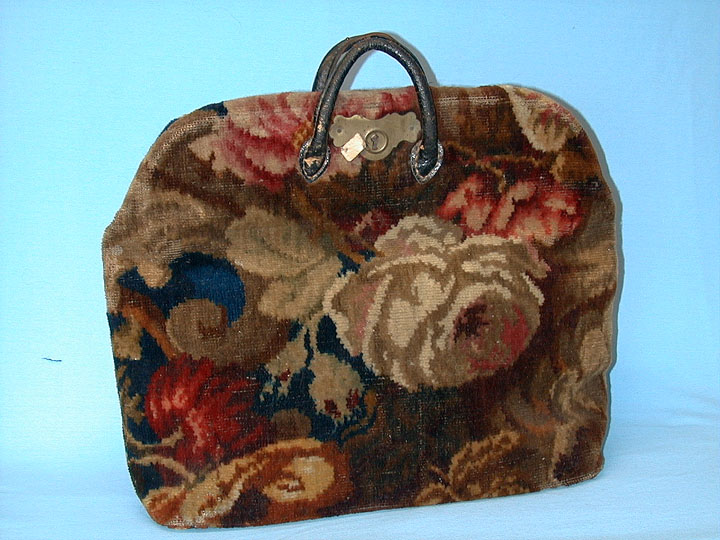
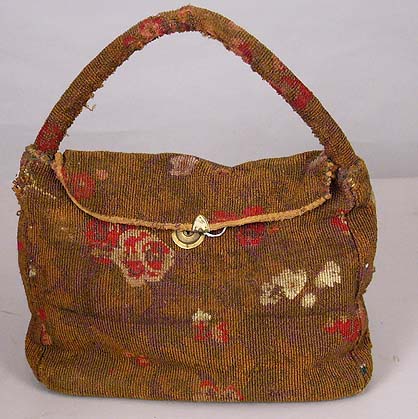
For an "overnight" stay... I have a carpet bag that will accommodate extra underpinnings, basic toiletries, and even a writing slope (but the slope won't stay level.. so the ink becomes a mess).  I generally need to bring a set of dishes and projects... so the basket comes along for those. A mattress tick gets filled with straw at the event, a blanket (or several for cold events), and a pillow and I have a cozy sleeping pallet.

For an outdoor on-the-move scenario, a bedroll of blanket and ground cloth for bedding, basket for food and utensils and I can move with the best of them. I own a pack basket and a market wallet for scenarios where the lack of  "ready menfolk" mean that a woman needs to carry a larger amount of communal "gear" for the group.

I gave some serious thought to the question and did a bit of (admittedly shallow) digging... and found that women seemed to be reaching for baskets more than bags for the day-to-day... a basket for market purchases, a basket to collect herbs, flowers, veggies, a basket to port laundry, a basket for sewing "stuff", a basket for knitting "stuff"... etc. So I try to make a basket my first inclination. Were the scenario to accommodate such... I might use a pillowcase instead of a bag or tie items into a large shawl and make a bundle of it.

To show a different side, I recently made a number of generally helpful carrying items for a Dear Friend who is a gentleman. I included a number of "poke sacks" of various sizes, a specially compartmentalized duffel bag for his specific impression with removable tidys, a period compartmentalized dishes/lunch carrier (based on a description I read in a period magazine, "sailor style" drawstring shoulder-sling duffel bag and a market wallet. (he declined a carpet bag or "carpet haversack" style bag, though there is plenty of reference for them)

Pouche Pompadour/ Traveling Sack
"Before Paper or Plastic: The Universal Basket" by Virginia Mescher
Carpet Bag
Bed Roll- Horse Collar style
Bed Roll- "Hobo" or "Short" style
Pack Basket
Pantry Box
Market Wallet
Poke Sack
"Sailor" Duffel (sailor-types sometimes call this a "ditty bag"
Travel Duffel
Carpet Haversack
Portmanteau
Valise, Satchel, Saddle Bag, Hunting Bag, and like